


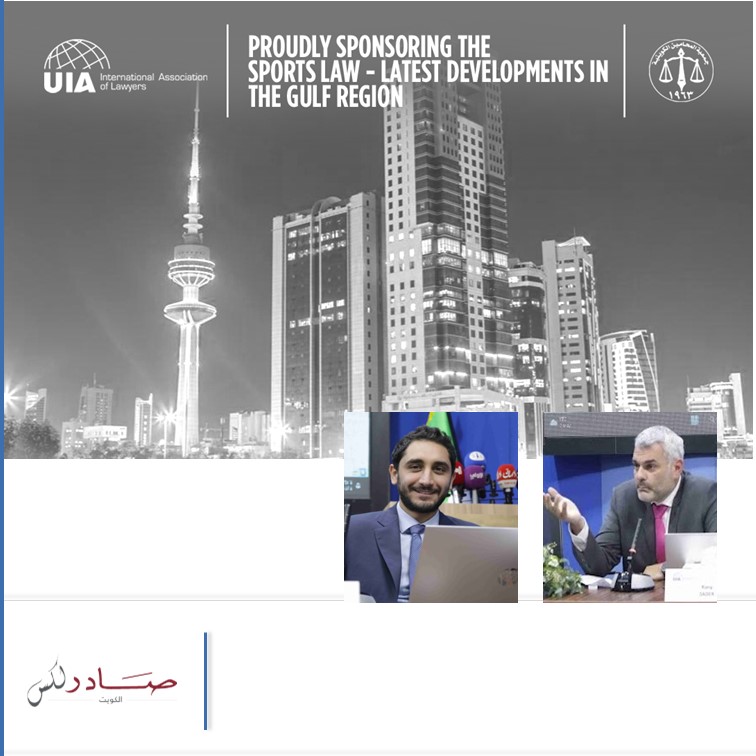
The International Union of Lawyers (UIA) in cooperation with the Kuwait Bar Association, organized a sports law seminar entitled " Latest Developments in the Gulf Region: Football, ADR and Professional Contracts", on the 12th and 13th of February 2023, at the Kuwait Bar Association headquarters, Kuwait City. The event was sponsored by SADER Legal.
The seminar started with opening remarks. The first speaker was Sheikh Fahad Nasser Sabah Al-Ahmed Al-Sabah, President of the Kuwait Olympic Committee and sponsor of the seminar, who expressed his pride that the State of Kuwait hosts such congresses that address important topics, including the legal aspects of players' rights in professional contracts. He also expressed the urgent need to develop sports law in Kuwait by amending the Sports Law No. 87 of 2017. The second speaker was Jorge Martí Moreno, Honorary President of the International Union of Lawyers, who thanked all the organizers of the seminar for hosting it in the State of Kuwait. He also stressed on the importance of the creation of the International Union of Lawyers, due to its objectives of cooperation between lawyers and the establishment of the rule of law. The third speaker was Sheryan Marzouq AlSheryan, President of the Kuwaiti Bar Association, who welcomed the participants in Kuwait and confirmed that the organization of this seminar by the Kuwait Bar Association expresses the ambition to promote sport in the Gulf and Arab countries, through the determination of a legal framework that settles sports disputes, leading to the realization of the concept of sports investment. For his part, the advisor of the President of the Union of International Union of Lawyers, Ali Al-Jabal, thanked everyone for the great organization of the seminar, stating that that the Kuwait Bar Association enriches the Gulf Area by organizing such seminars. He referred to several sports events organized by the Gulf countries, including the World Cup held in Qatar recently, highlighting that the sports field has become flourishing. Therefore, it is important for lawyers or athletes to keep up to date with the legislations. The opening session was concluded by the chairman of the Kuwait National Committee in the International Union of Lawyers, Abdulrahman Al-Tahous, who said that since Kuwait joined the International Union of Lawyers in 2019, the Kuwait Bar Association has participated in many seminars, even during the Corona pandemic. The State of Kuwait has become one of the organizers of these seminars and programmes among 152 countries and two million registered lawyers.
After the opening speeches, the activities of the first day of the seminar were divided into three sessions; the first session was entitled "Legal Means to Resolve Sports Disputes: Arbitration and Mediation", the second session was entitled "WORKSHOP: Player Contract Drafting Skills and the Role of Agents, Business Managers and Contractors" and the third and last session was entitled "WORKSHOP: Procedures of National and International Execution of Decisions / Tribunal Awards in Sports Disputes".
Legal Means to Resolve Sports Disputes: Arbitration and Mediation:
During this first seminar, five experts spoke. Firstly, Dr Abdul Wahab Sadeq, Vice Chairman of the National Sports Arbitration Tribunal in Kuwait (NSAT), spoke about the role of the NSAT and its various works. He started his speech by talking about Law No. 87 of 2017, which established this body and limited its competence to examining, adjudicating and deciding disputes of a sports nature. The law also defined its tasks, and among the most important ones is the settlement of disputes arising from sports contracts, the issue of professionalism and general assemblies. He also mentioned that the National Sports Arbitration Tribunal in Kuwait is composed of a board of directors in charge of defining the rules of procedure for arbitration and that the arbitration chambers have the power to judge and settle disputes. He also mentioned that the arbitration chambers are divided into two parts, the single arbitration chambers and the triple arbitration chambers. He concluded his speech by mentioning how the authority manages bureaucratic problems by managing cases, and he spoke about the problem that exists in article 49 of the sports law regarding the execution of decisions issued by the National Sports Arbitration Tribunal in Kuwait.
Secondly, Dr Najla Abdel-Rahman Al-Hekail, Assistant Professor of Law and Board Member of Saudi Sports Arbitration Center, spoke about the Saudi experience in the field of sports law enforcement in general, and sports arbitration in particular. She mentioned that within the framework of the 2030 vision, the Kingdom of Saudi Arabia has paid attention to sport, and as a result of this interest, the strategy of the Ministry of Sports was published, which deals with two parts, the first part is the development of clubs and the governance of sports clubs. The Ministry published a governance charter, which is a classification of clubs, where clubs shall have some basic criteria (strategy, leadership, management and operation, compliance, audit and financial control, marketing and events). The second law is the financial fair play law according to which clubs must not spend more than their income, to achieve club compliance and fight corruption. All these issues can lead to disputes which then reach the Saudi Sport Arbitration Centre. She also explained the divisions within the Saudi Sports Arbitration Center (SSAC) which consisted of ordinary arbitration dealing with matters related to sponsorship contracts or players. The Appeal Division considers appeals referred by the Dispute Resolution Chamber or the judicial commissions of the sports federations or the Olympic Committee. There is also an ad-hoc arbitration chamber that considers urgent applications and the Football Chamber competent to hear and adjudicate appeals against decisions issued by the Saudi Arabian Football Federation. She also mentioned that the decisions of the SSAC are final and not subject to appeal to the state courts. They are binding and not subject to appeal or negotiation, if the parties to the dispute are national. If one of the parties in the dispute is a foreigner, it is possible to appeal the decision issued by the Saudi Sport Arbitration Center (SSAC) before CAS, provided that the sports contract stipulates that. Her session ended with general recommendations on how to develop the field of sports arbitration in the Kingdom of Saudi Arabia and the Gulf region.
Thirdly, Portuguese Sports Lawyer Maria Alves spoke about alternative dispute resolution and focused on mediation. During her speech, she explained what mediation is and that the main difference with arbitration is that the mediator seeks to approach the two parties without finding a binding solution. She also mentioned which issues are subject to mediation on the basis of the CAS Mediation Code, which are all issues that are subject to CAS except those related to corruption and other ethical issues. She also spoke about the mediation procedures and what the role of the mediator is at this stage. She concluded her presentation by mentioning the advantages of mediation, including confidentiality, continuity of business relations and speed of proceedings. In the context of mediation, Alessia Sialino, Italian lawyer specialized in mediation, confirmed that the mediator does not find a solution to the dispute but the parties themselves reach a solution.
In the last intervention, Belgacem Mellah, former Minister of Youth and Sports in Algeria, raised several issues, the most important of which is the possibility of creating regional courts, before resorting to the CAS. Therefore, the litigation is at two levels, the first instance and then the regional appeal, and the decisive one is the international tribunal. Finally, he addressed the issue of empowering magistrates specialized in the field of sport, training lawyers specialized in arbitration, and restricting mediation to the settlement of minor amicable cases because arbitration is the efficient way to settle such matters.
WORKSHOP: Player Contract Drafting Skills and the Role of Agents, Business Managers and Contractors:
Three experts spoke during this workshop. Firstly, Manal Rmeity, legal counsel in the Qatar Stars League, presented the nature as well as the legal and regulatory implications of a professional contract. Manal pointed out that professional contracts have a special nature in terms of dependency and in terms of the legal provisions that govern such contracts. She stated that the condition of freedom of negotiation is not fully available in professional contracts, as professional contracts have been drafted in advance by professional bodies. She also presented the elements that must be included in the professional contract and the rights and obligations of each party.
The second speaker was Guilherme von Cupper, CEO of Berlin Sports. He spoke about the new FIFA regulations regarding players’ agents. He started his speech by listing the functions of the agents and presented the historical development of the agents’ regulations from 1996, when agents had a global license to perform their functions in all countries, until 2015 when FIFA changed this regulation and the agent now has to register in each national federation to exercise his activities and no longer has a global license. With the FIFA regulations for players' agents published this year, which will come into force in October 2023, agents have their global license back. In addition to establishing the agents’ chamber to settle disputes related to their work, FIFA has also set a cap on the percentage of agents’ commissions.
Finally, Dr Mohammad Al-Jaber, Director of the Department of Professionalism and Player Status at the Kuwait Football Association, spoke about the legal nature of professional contracts in the State of Kuwait. He said that the professional contract, in his opinion, is not an employment contract, but rather a nominate contract of a special nature similar to the employment contract. And he mentioned that in Kuwaiti law, there are two types of professional contracts: partial or government-supported professional contracts, and professional contracts binding players to the federations via the clubs with regard to the implementation of FIFA rules. It was concluded that partial professional contracts are not professional contracts but rather financial support contracts, as there are no prerequisites; i.e. the player’s income must be higher than his expenses. He also mentioned the Sports Law No. 87 of 2017, which states that national federations must establish their regulations in accordance with international regulations and federations, that was implemented by the Kuwait Football Association.
WORKSHOP: Procedures of National and International Execution of Decisions / Tribunal Awards in Sports Disputes:
During this workshop, the Acting Secretary General of the National Sports Arbitration Tribunal of the State of Kuwait, Maryam Al-Shemali, and the former Vice President of the Algerian Sports Arbitration Tribunal, Nasr Eddine Lezzar spoke.
Mrs. Maryam Al-Shemali explained how to submit a request for arbitration to the National Sports Arbitration Tribunal in Kuwait, what conditions must be met in the request so that the arbitrator does not nullify the proceedings, and the rules before the arbitration chambers after submitting the request for arbitration. She explained that the request for arbitration is very important and consists of 8 pages, the first page of which consists of the documents attached to the request for arbitration. After that, the application for arbitration is examined to determine the expenses and the arbitrators' fees. The power of attorney is very important; it must be valid. The information of the parties must also be specified. The last page of the form is very important, concerning the formation of the arbitration chamber: if there are several parties, then the chamber will be formed by three arbitrators. But if the dispute is unilateral, i.e. there are only two parties, then the claimant can propose the individual formation and specify the name of an arbitrator from the list of arbitrators accredited by the NSAT. Finally, the request for arbitration must be signed. The general rules of arbitration chambers are independence and impartiality, fairness of proceedings and equal treatment of all parties.
Mr Nasr Eddine Lezzar concluded the first day’s activities by talking about the enforcement of arbitral awards. He divided arbitral awards into two parts: national arbitral awards and international arbitral awards, and stated that national arbitral awards are implemented by a judge. As for international arbitration decisions, they must first be recognized based on the New York Convention, then they will be approved by the judge. He concluded his intervention with questions on the independence of arbitration bodies as they are sometimes affiliated to the Olympic Committee and on the transformation of arbitration clauses into acquiescence clauses because the referral to sports arbitration has become compulsory, thus eliminating the optional character of arbitration even though it is an alternative dispute resolution procedure.
On the second and final day of the seminar, the activities were divided into three sessions; the first session was “The Importance of Players’ Contracts in Avoiding Disputes in Accordance with International and National Regulations”, the second session was “Establishment and Management of Sports Companies. Actions and Their Impact on the Economy and Investment Sector” and finally the third session was “WORKSHOP: The Role of Industrial Property Rights in the Protection of Sports Events, and Trademarks and Commercial Names”.
The Importance of Players' Contracts in Avoiding Disputes in Accordance with International and National Regulations:
Ralph Charbel, Editor-in-Chief of Middle East Sports Law, international sports lawyer and arbitrator, member of the Beirut Bar Association spoke first. He started his speech by saying that the contract is the law of the contracting parties, and according to the principle Pacta Sunt Servanda, the contract protects the interests of the parties. Therefore, the contract must be properly drafted, i.e. it must not contain certain invalid clauses, and must not violate any mandatory article of law. Me. Ralph spoke about clauses that can invalidate professional contracts, including the non-reciprocal and unbalanced liquidated-damages clauses, and gave an example of two decisions by FIFA and CAS ruling on the invalidity of such clauses because they are non-reciprocal, unbalanced and arbitrary. Furthermore, the clause that provides for unilateral termination by the club if the player’s performance is not good is an invalid clause, according to the longstanding and well-established jurisprudence of the FIFA Dispute Resolution Chamber and CAS. Similarly, the clause that gives the club the right to terminate the contract of a player who has not played a certain number of matches is also considered invalid. Me. Ralph also mentioned that the designation of the competent body to examine the dispute in the contract would influence the decision to be made in the dispute. This is known as the jurisdiction clause. He added that FIFA is competent in disputes with an international dimension, even if there is no jurisdiction clause in the contract. This was the case of the Lebanese Professional Football Player Mustafa Kassab in his contractual dispute against the Iraqi club Al-Qasim, as there was no jurisdiction clause in the contract, but FIFA Dispute Resolution Chamber accepted the claim on the basis of articles 22 and 23 of the FIFA Regulations on the status and transfer of players. Therefore, it is not necessary for the contract to mention the competence of the FIFA Dispute Resolution Chamber for the player to have recourse to FIFA if the dispute has an international dimension. As for the possibility of making the validity of a professional player’s contract subject to the successful passing of the medical examination, Ralph Charbel confirmed that there is a difference between football and basketball in this respect, which explains the specificity of the laws of each sport. Finally, he explained the sporting nationality of the player, which determines the competent authority to settle his dispute against his club.
The second speaker was Guilherme von Cupper, who recalled the importance of the topic of this seminar from a preventive point of view, i.e. knowing how to formulate the contract in order to avoid mediation or arbitration, and focused on two basic contracts, namely the representation contract and the employment contract. He started by talking about the representation contract, the terms of which were determined by the FIFA regulations on agents. Mr. Cupper summarized these conditions in 5 basic elements that must be present in the representation contract for it to be considered valid. In fact, the representation contract must be in writing, the type of service provided by the agent must be mentioned, the duration of the contract must be specified provided that it does not exceed two years, the value of the agent’s income must not exceed a certain cap set by FIFA, and finally the terms of the contract must be clearly formulated, not vague and denying any confusion, in particular with regard to breaches and termination of the contract for just cause. The speaker also dealt with the player’s employment contract and stated that it is one of the very important contracts that must contain certain clauses to avoid conflicts. The most important is the value of the salary, i.e. how to determine it, and whether the salary will be paid in a certain number of instalments, whether the said salary is net or not, and other conditions. The duration of the contract should also be mentioned and attention should be given to the conditions for unilateral extension of the contract by the club, and finally to the conditions for dispute resolution. Mr. Cupper explained that in the context of an international dispute, CAS or FIFA would have competence in matters of arbitration, but it is preferable to indicate a jurisdiction clause in the contract for either of the two bodies, in order to avoid going to the ordinary courts in any case.
The third and last speaker, Naser Eddine Lezzar talked about the disputes that he has faced during his career as vice president of the Algerian Court of Arbitration for Sport. He presented a set of types or attempts to classify the disputes that have arisen and been brought before the Algerian Court of Arbitration for Sport by the players, and the origin and cause of these conflicts was always the negotiation or drafting of contracts. He pointed to disputes between players and clubs concerning non-payment of salaries and other disputes related to the players' intention to terminate a contract with a particular team.
Establishment and Management of Sports Companies. Actions and Their Impact on the Economy and Investment Sector:
This session started with a presentation by Mohammed Khaled Al-Mutawa, Secretary of the Board of Directors of the National Sports Arbitration Tribunal, entitled “Establishing Sports Enterprises under Kuwaiti Law”. Before getting into the heart of the matter, Mr. Mohamed started with an introduction on the importance of sport in leaving a historical mark and taking care of education. He then began to explain how to create companies under Kuwaiti law. Companies in Kuwait are of two types, the first one is a company whose object is a sports game registered with the International Olympic Committee, and then a private company is created to enable it to manage this sports game. The second type is the establishment of a company in the field of advertising. The club can set it up and own it 100%, and the company can be a limited liability company or a one-person company. He also mentioned the possibility of changing the legal entity of the club, i.e. turning the legal entity into a company. He discussed the intervention in the creation of the company by the authority, as its approval is a condition for a license to be issued. And he mentioned an example of Kuwait Sports Club in 2019, which established a company whose purpose is to manage the football game in the club.
The second speaker was Dr Georg Froese, founder and owner of the Berlin Sports Group, who spoke about the purchase of football clubs on the basis of FIFA's third-party regulations. The investor can manage the club or buy the club in order to invest in the players' rights. One of the changes in these regulations is the multi-club’s ownership. He gave the example of Red Bull. Dr Froese also explained how the investor can benefit from buying the sports club, often for non-sporting reasons, to make a profit or sometimes to cover up illegal activities such as money laundering. He also mentioned that the club could look for an investor if it was financially insolvent, which is what happened during the Corona crisis. Finally, he recalled the duty of deliberation in decision-making, whether on the part of the investor or on the part of the club, so as not to be misled.
In the third intervention, Portuguese Sports Lawyer Maria Alves gave an example of investment in football by mentioning a case related to the Portuguese club Belenenses. Me. Maria clarified the rules of Portuguese law regarding clubs that participate in professional tournaments, they must create sports companies. This established company must be composed of at least 5 shareholders, and one of the shareholders is the main sports club. According to Portuguese law, this sports club has advantages, the most important of which is that it holds 10% of the shares of the sports company, that it conditions the non-change of the identity of the main club, the name, etc. Thus, the company that has been created has rights, it can use the assets of the club, such as the stadiums.
In the fourth intervention, Fouad Al-Mazeedi, Secretary General of Al-Arabi Sports Club, spoke about the financial and administrative challenges and obstacles facing Kuwaiti sports investments. He gave several examples of these obstacles, such as the minimal amount of money to buy foreign players, the process of buying clubs is impossible because there are no assets, such as stadiums that are old and unsuitable for play. At the end of the speech, Fouad Al-Mazeedi hoped to improve the situation of the sports industry in Kuwait.
In the last speech, Essam El-Hadary, the former goalkeeper of the Egyptian national team, spoke about several ways for the sports club to get profits, giving the example of Al-Ahly club, whose sponsorship income amounts to 500 million Egyptian pounds. He believes that the club's income achieves several goals, including qualifying players and bringing them into the ranks of Al-Ahly club, and thus achieving the desired championships and goals. To succeed, the club must establish a company that brings investments through academies that train players. He gave the example of the former club of Mohamed Salah Al Moukawiloun Al Arab that reaped benefits from Mohamed Salah until 2021.
The seminar concluded with a presentation entitled "The Role of Industrial Property Rights in the Protection of Sports Events, and Trademarks and Commercial Names", given by the Chief Legal Innovation Officer at Sader Legal and intellectual property expert, Attorney Rany Sader. Me. Rany considered that sports law and intellectual property are closely linked. In his speech, he spoke about the different applications of intellectual property in the field of sport. Copyright protects all aspects of a sporting event, as the World Cup in Qatar shows. From the World Cup logo to the dances and songs, everything about this sporting event was protected by copyright. He also addressed the issue of television broadcasting of matches, and the fact that the media is an integral part of sport and is also part of copyright. He gave an example of the player Cristiano Ronaldo and his transfer to the Saudi League, where Saudi Arabia spent huge amounts of money, but this is a development and progress for the sports industry in Saudi Arabia, as there are 30 countries broadcasting the Portuguese player's match, which is a return on investment. He also addressed the issue of trademarks, as they differ from copyrights, which are how products appear to the public, whereas copyrights, include everything related to culture. Attorney Rany Sader gave the example of the Nike company and the value of its name alone is $213 billion. He also addressed topics such as industrial design in relation to the design of Formula 1 cars, he also talked about patents at the Paralympics. He then tackled the metaverse and the fact that sports federations have already started to invest in these areas. Rany Sader concluded his speech by talking about intellectual property disputes which usually arise from the interpretation of contracts, as well as from the violation of the player's image rights, for example, and the misuse of the trademark and other reasons.
The seminar concluded with an appreciation speech from the President of the Kuwait Bar Association, Sheryan Marzouq Al-Sheryan.